The Never Ending Argument of Occupancy vs ADR.
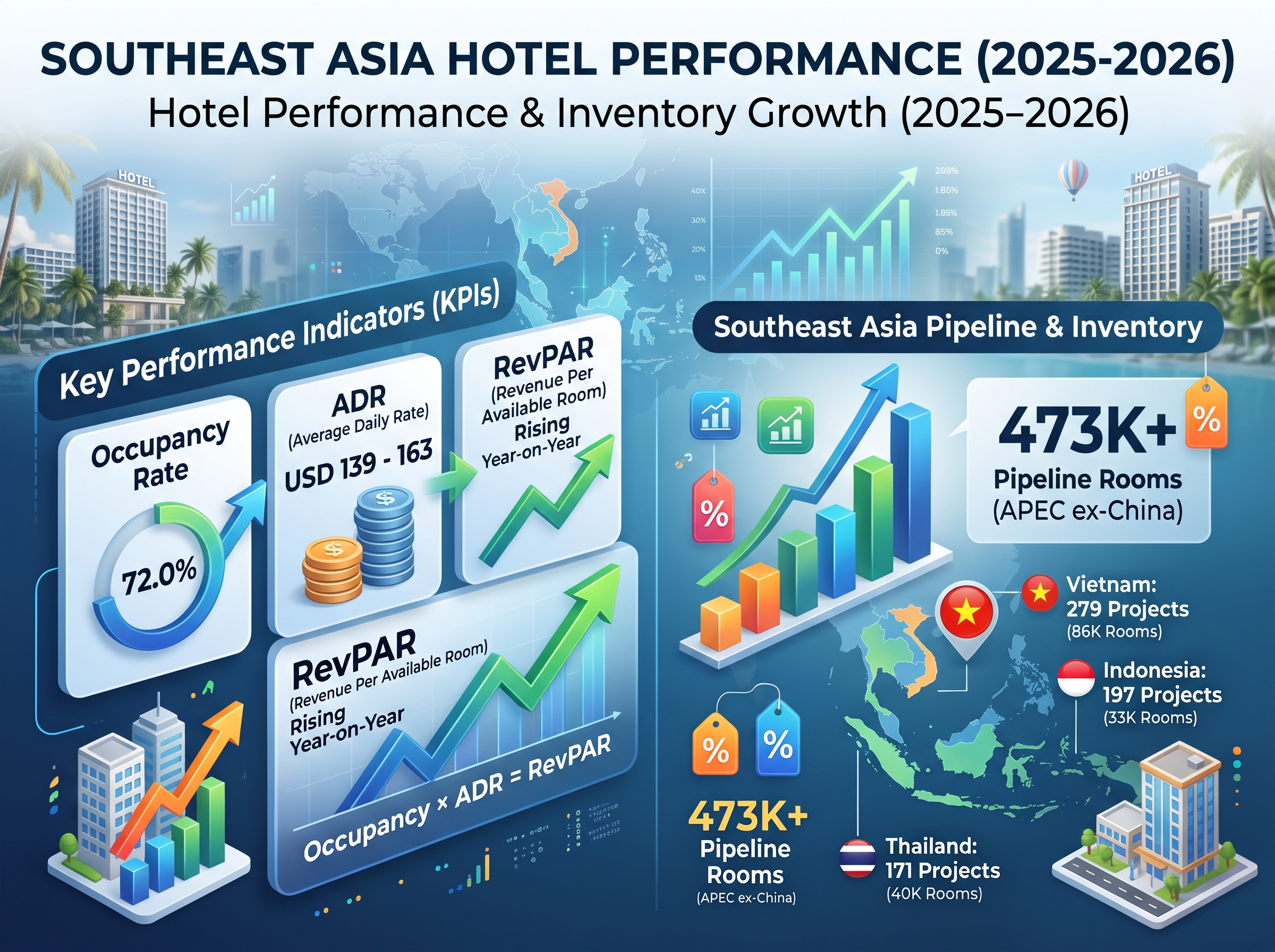
The recent November 2026 regional hospitality data exposed a massive operational paradox across Southeast Asia: Higher occupancy did not contribute to higher profitability.
Right now, the region is staring down a staggering influx of new inventory. At the close of Q3 2026, the Asia-Pacific development pipeline hit an all-time record of 2,684 projects. Southeast Asia is the epicenter, with Vietnam (279 projects), Indonesia (197), and Thailand (171) leading the charge. Bangkok alone is preparing to absorb 71 new properties into its urban grid.
Our immediate competitive instinct is always to re-set our compset, and adjust pricing accordingly. The main trigger is always fear, that our market share will be taken, accepting the fact that the pie did not grow bigger. And from the perspective of the new comer, rates will be even more competitive, to seek market acceptance first.
Look at the tale of two markets: Bangkok vs. Phuket.
The Volume Trap: Bangkok operators chased market share. They successfully pushed occupancy up by 1.1%, but to secure those heads in beds, they compromised on rate, dropping ADR by 2.1%. The result? A net RevPAR decline of -0.6%.
The Yield Victory: Phuket operators took the opposite approach. They accepted a 3.2% drop in occupancy, but aggressively pushed ADR up by 5.3%. The result? A net RevPAR increase of +1.1%, delivered with significantly lower operational overhead.
But does this effectively tell us the real story, what about the "what-ifs" tied in with every decision made? And results can only be seen or proven over time.
What if you do not drop ADR and loses even more in occupancy, Owners will be the first to breath down your neck and question why wasn't any measures taken, ie drop rates. And if you were to raise ADR to compensate for lower Occupancy, what do you gain?
On one end, when we drop ADR to steal a few extra room nights, we also actively drive up variable operating expenses—housekeeping payroll, laundry, and energy consumption (ECOR)—while simultaneously accelerating the physical degradation of the property, working our staff harder and degrading asset faster (and make less money as a result).
I was looking through this argument in my head, and I could not draw a conclusive decision on what is the right move to make, but I am convinced that there isn't any one-size-fits-all solution to this, simply because it is all dependent on the property itself. Its location, concept, the nature of the operations, its resources and so on, all impacts the decision, and seasonal changes also warrant shift in strategy as and when needed.
This is what we do best as a management company, we plan, study, test and execute strategies at the right time, right place, to ensure a balanced result at competitive times, and a bullish one when it is the right time to be aggressive.